
RESEARCH
Our research uses engineering to solve clinical problems and advance human health. We aim to develop new ways to tinker with the body with greater spatial and temporal resolution to diagnose and treat disease. This work can be divided into two areas: neuroengineering and translational medicine.
NEUROENGINEERING
We develop approaches to precisely target the nervous system through the brain and gastrointestinal tract using a circuit-level understanding of neurological disease.



Ingestible Devices
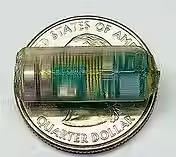
The gastrointestinal tract harbors an extensive number of neural, hormonal, and microbial circuits. We develop ingestible devices that navigate and interact with these pathways non-invasively. FLASH delivers electrical stimuli to the stomach, and ICOPS is remotely-actuated to deliver photostimulation. IMAG acts as a GPS system for the gut, while CORAL leverages geometric microstructures to entrap gut microbes.


Neural Drug Delivery Systems
Miniaturized neural drug delivery systems (MiNDS) are modular technologies for chronic targeting of deep brain structures, combining fluidic and electrical interfacing.


Ultra-thin Flexible Brain Microprobes
Brain probes are often thinner than a human hair, making them difficult to insert into tissue. We utilize mechanical shapes to enable independent insertion along curved trajectories, as demonstrated by SPIRAL, a helical microfluidic catheter for minimally invasive, multiregional intracerebral drug delivery.


Computational Tools for Neural Targeting
Brain structures are a wide range of shapes and sizes. This makes it difficult to accurately target regions. COMMAND is a computational toolkit to optimize coverage for maximum efficacy and minimal toxicity.
TRANSLATIONAL MEDICINE
We have worked on a number of projects focusing on improving health care for patients. These range across a number of disciplines, including nanotechnology, immunology, and clinical care.
Safe Splitting of Ventilators Among Patients
Driven by the urgency of the COVID-19 pandemic, we developed iSAVE, a system for safe splitting of ventilators across multiple patients. We founded a non-profit, Project Prana Foundation, which has shared this technology with multiple countries. This technology is currently in human trials.

Machine-Learning Driven Cancer Sensitivity Screening
A major obstacle in cancer care is determining which drugs might be most effective for each patient. We developed an implantable microdevice which could be used to assess tumor sensitivity in only 24 hours, utilizing machine learning classifiers to infer drug susceptibility of patient-specific tumors.

